
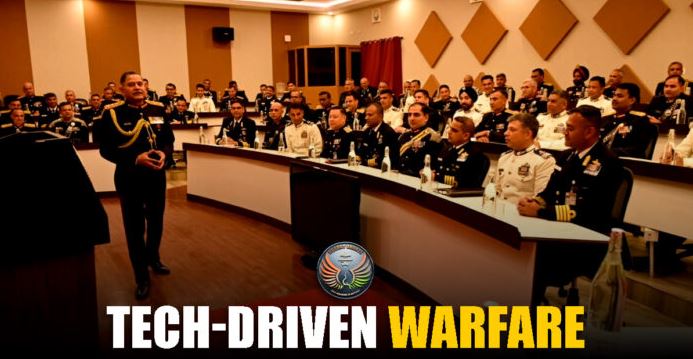
New Delhi | The Ministry of Defence (MoD) has unveiled the Technology Perspective and Capability Roadmap (TPCR)-2025, a comprehensive 15-year strategic blueprint outlining the future technological and capability requirements of India’s Armed Forces. The roadmap signals a decisive push toward advanced systems such as hypersonic missiles, nuclear propulsion platforms, directed-energy weapons, and unmanned and autonomous warfare technologies.
Guiding India’s Defence Future
TPCR-2025 provides early visibility of the Indian Army, Navy and Air Force’s long-term capability requirements, enabling domestic industry, academia and research institutions to align their research and development efforts accordingly.
The latest edition follows earlier versions released in 2013 and 2018. According to the MoD, feedback from industry stakeholders on TPCR-2018 led to multiple Acceptance of Necessity (AoN) approvals and contracts, underlining the document’s practical impact on defence procurement and indigenisation.
The core objective of TPCR-2025 is to strengthen self-reliance in defence manufacturing while preparing the military for emerging multi-domain warfare challenges, including cyber, space and AI-enabled conflicts.
Navy: Expanding Reach in the Indo-Pacific
Under TPCR-2025, the Indian Navy is set to enhance its blue-water capabilities with nuclear propulsion systems and a next-generation aircraft carrier equipped with an Electromagnetic Aircraft Launch System (EMALS).
The roadmap also proposes induction of destroyers, corvettes, Landing Platform Docks (LPDs), Autonomous Underwater Vehicles (AUVs) and fast interceptor craft. These additions aim to bolster maritime security, anti-submarine warfare strength and coastal defence, reinforcing India’s strategic footprint in the Indo-Pacific region.
Army: Modernisation for Border and Hybrid Warfare
The Indian Army plans to replace its ageing armoured fleet with approximately 1,800 Future Ready Combat Vehicles (FRCVs) and induct light tanks designed for high-altitude mountain operations, addressing operational needs along northern and western borders.
The roadmap further highlights acquisition of Anti-Tank Guided Missiles (ATGMs), integration of Unmanned Aerial Vehicles (UAVs) with loitering munitions and deployment of robotic systems for counter-Improvised Explosive Device (counter-IED) operations. These measures reflect preparation for network-centric and hybrid warfare scenarios.
Air Force: Directed-Energy and Deep-Strike Capabilities
For the Indian Air Force, TPCR-2025 envisions deployment of directed-energy weapons such as laser systems and stealth bomber drones to enhance deterrence and deep-strike capabilities.
The use of High-Altitude Pseudo-Satellites (HAPS) and stratospheric airships is also planned to ensure persistent Intelligence, Surveillance and Reconnaissance (ISR) capabilities and secure communications, particularly in potential two-front conflict situations.
Tri-Services Push: Hypersonic and AI Integration
A major highlight of TPCR-2025 is the proposed development and induction of over 500 hypersonic missiles powered by scramjet propulsion systems, alongside universal missile launchers to enhance interoperability across the Army, Navy and Air Force.
The roadmap also emphasises adoption of Artificial Intelligence-enabled cyber tools, quantum communication networks and satellite-hardening measures to strengthen resilience against cyber warfare and space-based threats.
Cross-Cutting Technologies and Sustainability
Beyond platforms and weapons, TPCR-2025 underscores the use of Artificial Intelligence (AI), Machine Learning (ML), digital twin simulations and autonomous systems to enable predictive, data-driven warfare.
The document also integrates sustainability into defence planning, promoting green logistics and energy-efficient systems as part of India’s broader national strategy.
Toward Self-Reliance and Strategic Deterrence
With TPCR-2025, the Ministry of Defence aims to provide industry with a clear technology vision while accelerating indigenisation under India’s self-reliance goals. The roadmap marks a significant step in preparing the Armed Forces for next-generation, multi-domain warfare over the coming decade and a half.









Leave a Reply