
India’s independence in 1947 was not the end of struggle—it was the beginning of uniting a land fractured by 562 princely states. This monumental task fell upon Home Minister Sardar Vallabhbhai Patel and his trusted aide, V.P. Menon. Through determination and diplomacy, they persuaded rulers to accede to the Union, making India one nation.
Among the most difficult cases was the princely state of Hyderabad. Though 85% of its population were Hindus, the Nizam’s regime kept all civil, military, and administrative power in the hands of Muslims. The Legislative Assembly, too, was structured to ensure Muslim dominance. Denying basic rights to the majority, the Nizam dreamed of making Hyderabad an independent Islamic state. Backed by his private militia, the Razakars, led by Kasim Rizvi, the state unleashed a reign of terror—villages were looted, Hindus were massacred, and women suffered unspeakable atrocities.
The Nizam also sought foreign help, acquiring arms through illegal networks, and even looked towards Pakistan for support. His regime, strengthened by the Majlis-e-Ittehadul Muslimeen, propagated the idea that Muslims were rulers while Hindus were destined to be ruled. This deepened communal oppression and led to violent clashes across Telangana.
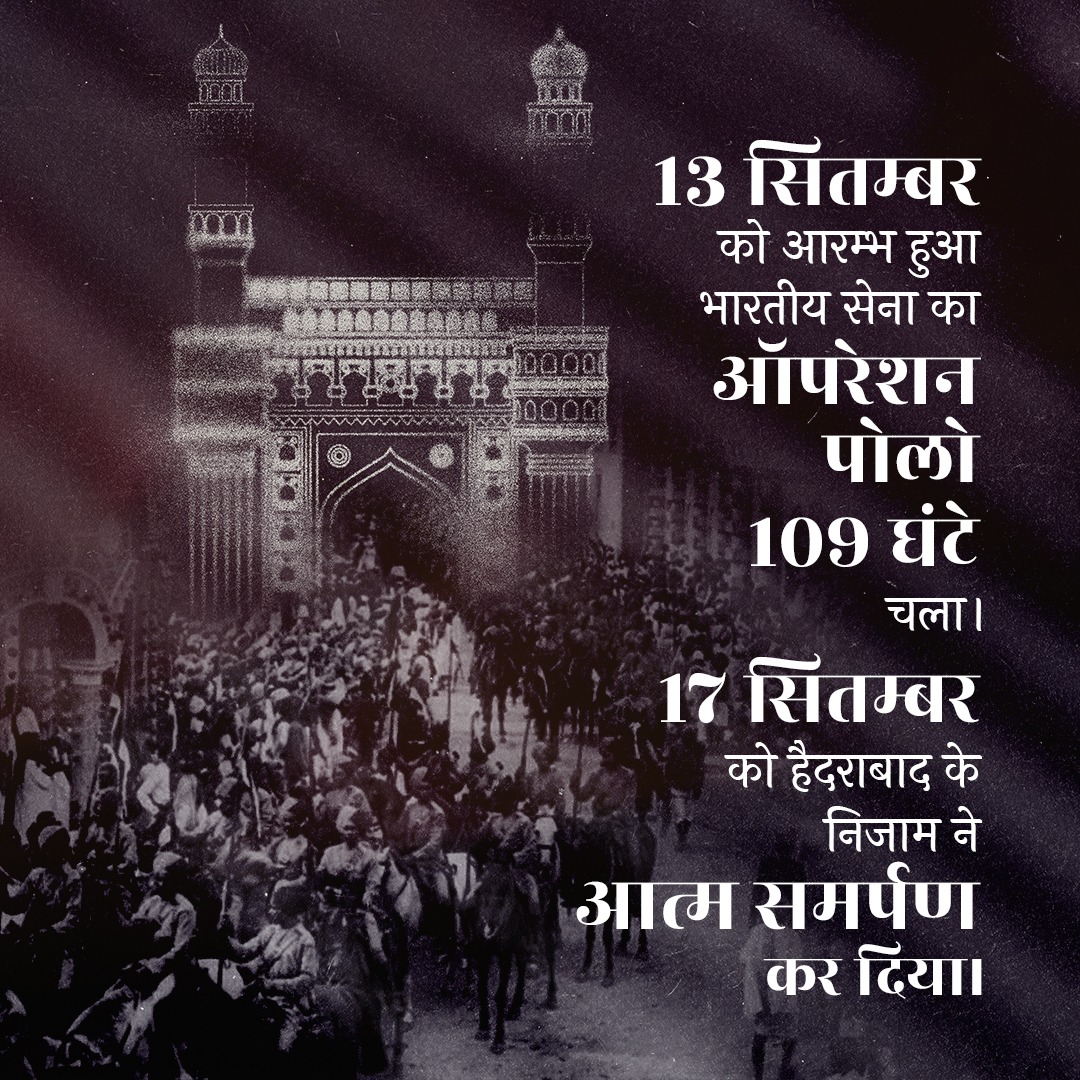
As patience ran out, the Government of India launched “Operation Polo” in September 1948, a swift military action to end the tyranny of the Razakars. Within days, the Nizam surrendered, and Hyderabad formally acceded to Bharat.
This victory was more than a military triumph—it symbolized the triumph of unity, justice, and democracy over tyranny and religious bigotry. The integration of Hyderabad ensured that the people of the state could finally breathe the air of freedom and equality in independent India.
Hyderabad Liberation Day reminds us that independence was not a single event of 1947, but a continuous struggle to secure dignity and justice for every Indian.


Leave a Reply